


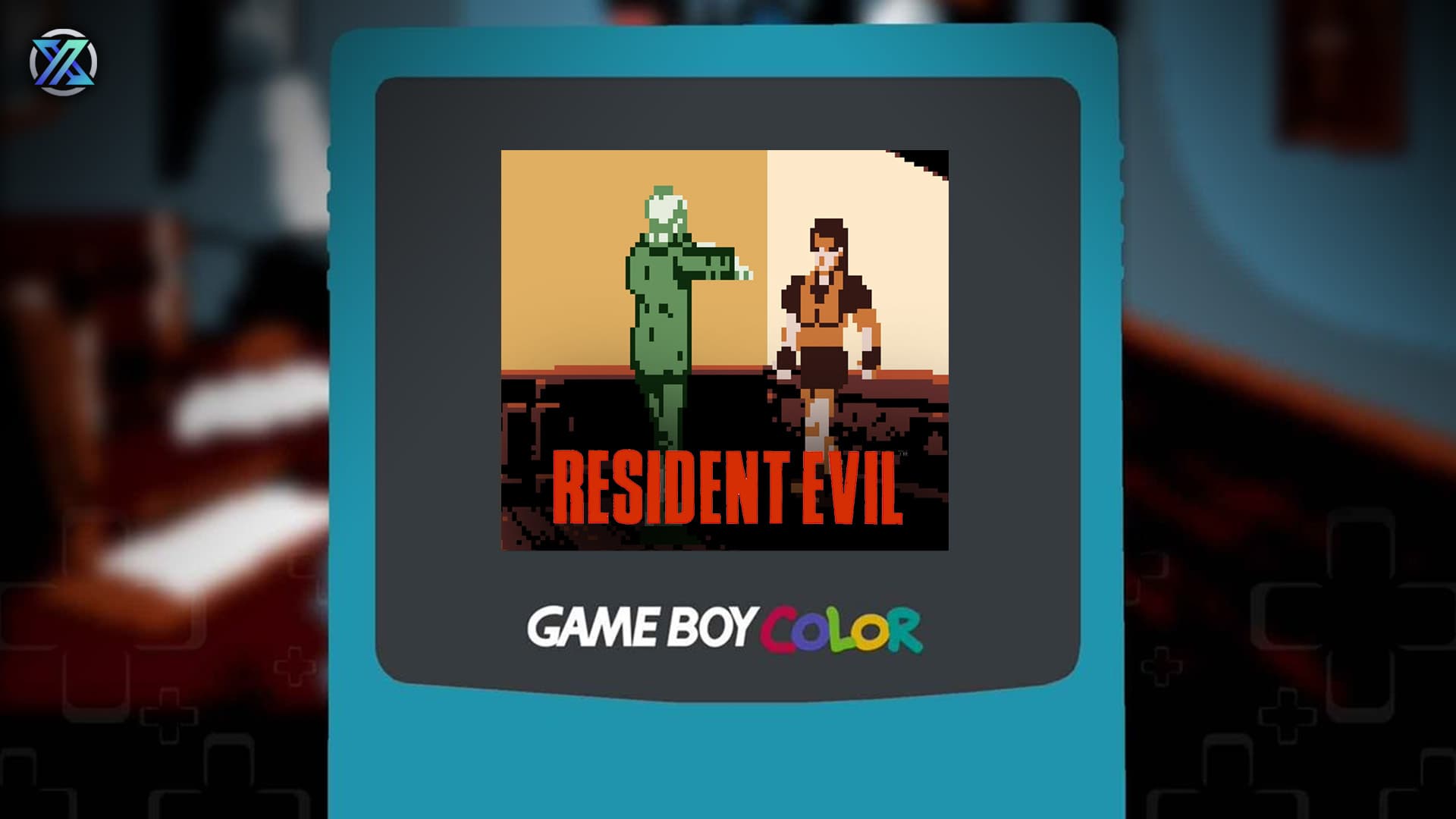
One of the most interesting digitals “what-if” scenarios in the gaming world has come back to life after several decades. A Game Boy Color port of the original Resident Evil, which was canceled for a long time, has recently leaked on the internet, and it is said to be in a playable state that is very close to the final version. This gives the gamers a rare chance to see one of the most daring adaptations of that time for handheld devices. The leak has led to a revival of interest in survival horror development, limitations of handhelds, and Capcom’s willingness to experiment way beyond the expectations in the late '90s.
Although the project was silently put on hold before it could see the light of day, the build that has just emerged hints that the Game Boy Color version of Resident Evil was much more finished than what had been the case up to now and also that it was pretty much at the time of release that history had imposed on it.
A Forgotten Chapter in Resident Evil History
The first Resident Evil game that was launched in 1996 became a major contribution towards establishing the survival horror genre with its fixed camera angles, puzzle-solving gameplay, and fearsome atmosphere. The PlayStation version of the game became very popular, and Capcom started contemplating ways to cater to other markets, even bringing the game to Nintendo's handheld devices.
Advertisement
Back then, Game Boy Color was a leading device in the market though it was not on par with the home consoles in terms of performance and capabilities. But then again, Capcom let the project of developing a Resident Evil for the handheld go ahead at the same time of trying to recreate the essential horror experience on a device that was not already intended for horror movies.
Advertisement
For a long time, the information about this project was known only through the occasional interview, low-res pictures, and quick references in the history of game development. Most people thought the port had been cancelled very early in the process. However, the recent leak changes that point of view totally.
What the Leaked Build Reveals?
People who have seen the leaked documents claim that the Resident Evil Game Boy Color version is almost finished as it contains almost everything, including environments that can be played, enemy encounters, puzzles, and many spots from the original game that can be recognized.
Advertisement
The game is said to have :
- Rooms that can be explored to the fullest inspired by the Spencer Mansion
- Characters that can be played and are similar to Chris Redfield and Jill Valentine
- The inventory management systems designed for handheld controls
- The enemy AI and combat mechanics that are made for 2D presentation
Instead of trying to copy PlayStation’s pre-rendered backgrounds, the GBC port takes a top-down view like the early action-adventure games. Even though this change was made, the mood is still even more so of Resident Evil with the creepy sound and slow pacing that are the game’s characteristic features.
The presence of different environments and systems suggests that the project was already very close to being finished, thus raising questions about the reason for its ultimate cancellation.
How Resident Evil Was Reimagined for Game Boy Color?
Transforming Resident Evil for the Game Boy Color involved very huge creative sacrifices. With the restrictions of the handheld's resolution, color display, and processing power, the survival horror genre presentation was basically ruled out.
The programmers went for developing a tile-based 2D engine, concentrating on playing and understanding the game instead of realism. Characters are simply small sprites, while the surroundings are easy to tell apart but not very complicated. The original mansion's structure is still intact with its doors, corridors, and rooms which ensure that exploration and backtracking that are typical of the franchise are still there.
Combat is also seen as very simple. There is no manual aiming here. Encounters, however, are very much about the right position and timing making the experience very accessible considering the control constraints of the handheld.
What they ended up with was not a direct port but rather a reinterpretation, a version of Resident Evil that is of the Game Boy Color but at the same time, the franchise's identity is still there.
Why the Project Was Canceled?
Capcom's Game Boy Color port, despite seeming to have made significant strides, was still largely canceled, and the company never gave any reason for its decision. The unauthorized build has brought back the discussion around the reason for the cancellation.
One possible reason could be the timing of the market. Capcom had already started to look for more advanced hardware like Game Boy Advance and newer home consoles by the early 2000s. They might have thought investing more in a platform that was already technically limited would not be very practical anymore.
Quality control can be another reason. If the game was playable, Capcom might have considered that it could not meet the expectations of the Resident Evil brand which was already getting more and more cinematic with the newer entries, especially as the series was going through changes.
Licensing, internal changes, or poor directing might also have been factors. However, the cancellation of the project, whatever the reason, still meant that it was never seen again, until now.
The Significance of the Leak
The presentation of this near-final version is important not only for Resident Evil aficionados but also for the whole game conservation. The history of game development is interrupted by the sometimes irreversible loss of canceled projects, and these gaps can never be completely understood.
In this context, the leak offers :
- Understanding of Capcom's inventive thinking and trying-to-find-out ways during the early stages of the series
- A rare case of a highly ambitious handheld version in the late '90s
- An artifact to play that unites the history of survival horror and portable gaming
Moreover, it underlines the extent to which developers were prepared to go to make the hardware do more than it was designed for.
Community Reaction and Fan Fascination
The response from the gaming community has been nothing short of ecstatic. Veteran players are amazed at the game’s ability to accurately reflect Resident Evil’s atmosphere even with less than perfect technical support. Meanwhile, others are in awe of the great ambition of shrinking such a multifaceted experience to a Game Boy Color cartridge size.
A few enthusiasts have even gone as far as saying that if it had been released, the game could have been the one to determine the direction of handheld horror design many years earlier. There have been some up to the point of comparing it with later games that rather successfully introduced and distributed adult themes amongst the portable platforms.
Surprisingly, on the other hand, the feeling is mixed with a tinge of sweet nostalgia. The shocking realization of how close the project was to finishing makes the cancellation even more unfortunate.
Legal and Ethical Questions Around Leaks
Like all leaked materials, the revival of the Game Boy Color Resident Evil comes with legal and ethical implications. The game still belongs to Capcom and its unauthorized distribution is in a legal gray area.
The preservationists say that leaks are a source of gaming history while the publishers consider them as copyright infringement. Capcom has not given any public response regarding the leak so it is uncertain whether any takedown actions will happen.
The companies have varied their responses in the past, at times they did nothing and the interest just faded, and the other times they were taking very strict removals. For now, the leak is still going around the enthusiasts and the historians.
How Important Is This For Resident Evil’s Legacy?
The finding of this nullified port has enriched Resident Evil's legacy by one more layer. It substantiates the belief that the franchise's triumph was not merely due to one formula but rather, it was the result of continuous experimentation across all platforms and in all genres. The discovery of this canceled port also brings to light Capcom's recognition of the franchise's versatility very early in time.
The company even found creative ways to introduce its flagship series to new audiences when the restrictions due to the hardware were very tight. The Game Boy Color version, to be viewed in retrospect, should be perceived as a proof of concept as to how flexible Resident Evil could have been or in other words, how different its history might have been in case the project had made it to the shops.
A Glimpse Into an Alternate Gaming Timeline
A Game Boy Color port would have opened the door for the survival horror category to be targeted at the younger, portable-oriented audience long before the expected time. It would have altered the general opinion regarding the limits imposed on portable games, thus allowing the darker, more intricate portable experiences to come in.
The project, however, was not only kept secret for a long time but also became a minor mention in the history of development. The recent leak, however, turns that minor mention into a real piece of gaming history.
Conclusion : A Lost Game No Longer Forgotten
The leak of the Game Boy Color port of Resident Evil that was never released offers an unusual and interesting view into one of the nearly forgotten experiments from Capcom's history. More finished than anyone thought, the game is a witness to the ambition and inventiveness that characterized the very first survival horror development stages.
Although the game might not be officially released ever, its rediscovery will make sure that this lost segment of Resident Evil's history will not disappear into oblivion again.